
Nick and I talked for years about building a product alongside our MSP and selling it one day. We built plenty of software for ourselves along the way, but we never got there. So we were delighted to welcome back Tas Gray, who actually did it.
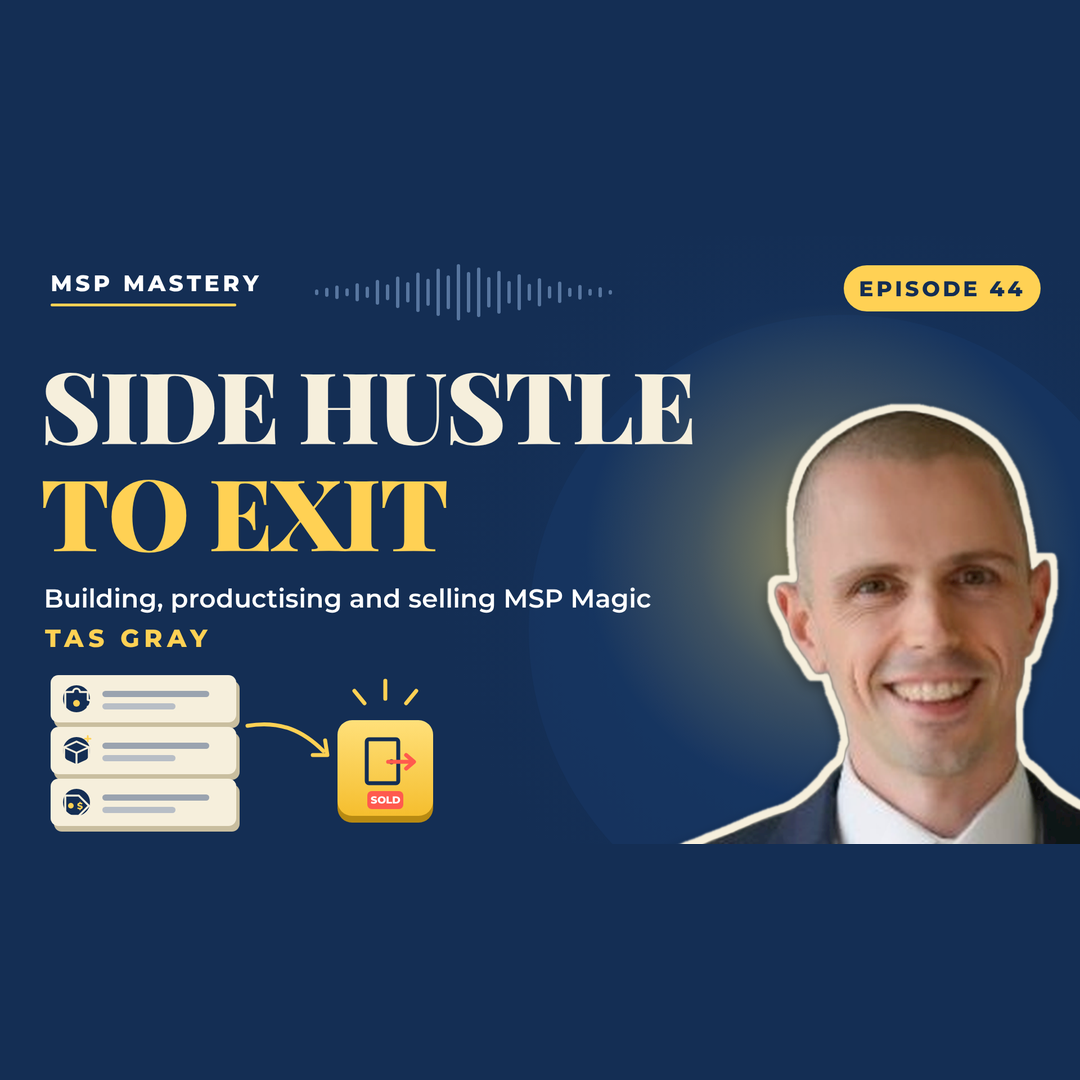
Tas is the founder of Axiom IT and joined us first in episode 31. With a background in software development before starting his MSP around 13 years ago, he is known for automating business processes and building smart systems. In this episode of MSP Mastery, he shared the story of building MSP Magic, a multi-tenant Microsoft 365 management tool, and selling it.
A Gap in the Cloud
The story begins around 2018 or 2019 with what Tas calls the second wave of Microsoft cloud. Office 365 became Microsoft 365, Business Premium arrived, and Windows devices could be joined to Azure AD and managed through Intune instead of on-premises servers and Group Policy. As a cloud-first MSP, Tas was excited. Clients no longer needed to buy servers to get proper device management.
What was missing was tooling to manage it all across many client tenants. Lighthouse, CIPP and Inforcer did not exist yet. It was a greenfield opportunity.
Nick reflected that lots of MSPs have built software to solve their own problems. In our early days we wrote our own PSA twice, first with technicians bringing timesheets back to the office on floppy disks and later in Lotus Notes, before moving to Autotask. Very few turned that work into a commercial product.
Productise It, Do Not Keep It
Tas’s team had built enough capability internally to solve the easy problems, but going further would take significant investment. Having solved problems in the past and kept the solutions to himself, he felt he had missed opportunities. This time, if they were going to invest, they would build it in a generalised way they could productise and take to market.
From day one MSP Magic was its own business, with its own registered entity and an additional partner. Nick admired that approach. We once sank around $200,000 of our MSP’s profit, roughly a year’s worth, into building project management software with a partner who held the IP. We sold it once, and that implementation ended badly. Tas was quick to point out that separate entities do not remove the risk. When you own multiple businesses, one usually funds the other, and they could still have lost a lot of money.
The Easy Part Was Selling
One of the things that appealed to Tas about a SaaS product was that selling services is hard, while a product that solves a real problem can almost sell itself. He had seen that with an earlier, simpler licensing sync tool. For MSP Magic, marketing meant building a website, joining the conversations on Reddit and telling people about it. With so little else available, leads came in from around the world.
The challenge came later. They ran uncontested for a while, then seemingly overnight faced around ten competitors, including a free open-source option. Nick added that the pace is even faster today, with AI builders seeing whole products wiped out when a major AI provider releases a new feature. Building a minimum viable product is relatively easy. Turning it into a commercial product is still a massive task.
Deciding to Sell
Tas has always built businesses with a view to selling at some point, but MSP Magic was not built purely to sell. It reached a solid level of recurring revenue and covered its costs, but going to the next level required a large injection of capital. Just as they started looking, the venture capital that had been flowing dried up. With competitors closing in, there was a limited window, and selling became the more appealing path.
They received interest at several points along the way. Initially they were not interested, but over time it became clear there were things they could not overcome without the backing of a larger company.
Choosing the Right Buyer
MSP Magic was acquired by Hornetsecurity, a large German vendor in the Microsoft space whose suite already covered email protection and backup. Tenant management was a gap they wanted to fill, and after assessing the market they liked what Tas’s team had built. The deal was finalised in early 2024.
What gave Tas confidence was the buyer’s track record. They had made many acquisitions, and he could speak with founders who had been through the process, including a team from an earlier acquisition who were still with the company years later. The terms were favourable, with no lock-in arrangements. The CEO flew to Melbourne and spent a week getting to know them.
Tas’s view is that no amount of contracts or lawyers can fully protect you if someone sets out to do the wrong thing. In the end, you have to judge character to the best of your ability. Nick agreed. Whether you are selling a product or an MSP, it is your baby, and you need to understand the buyer’s motives and where it is going.
The MSP Goes On
Tas also considered selling Axiom IT at various points, which was a far more emotional question. MSP Magic was never about him, but his MSP is a big part of his identity. Restraints in any deal would have stopped him starting another MSP, and in the end he did not sell. As I said in the episode, the MSP does go on without you, as wounding as that is to the ego.
Running an MSP and a SaaS business at the same time for over three years, Tas said, probably took ten years off his life. Ironically, the moment he started MSP Magic, the MSP took off, especially once COVID hit. He needed a year or two to decompress afterwards.
The Lesson
If Tas did it again, he would fully remove himself from any other business that depended on him so he could give the new venture his complete attention. Unless you have really good people around you, a side hustle cannot stay a side hustle. Nick agreed. The people he has seen pivot successfully build the leadership team to run the existing business, then put almost all of their focus into the new one.
Let’s Keep the Conversation Going
Building and selling a product alongside an MSP is harder than it looks, but Tas proved it can be done. If you have an idea you have been sitting on, connect with Nick, me and the MSP Mastery team to keep the conversation going.